
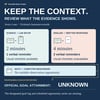
IEP Teacher Input Forms & Follow-Up Toolkit | Editable Special Education
IEP Teacher Input Forms & Follow-Up Toolkit | Editable Special Education
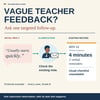
Vague teacher feedback? Know what to ask next.
Collecting classroom teacher input for IEP progress reporting can be challenging—especially when the responses are too general, missing important details, or based on different classroom conditions.
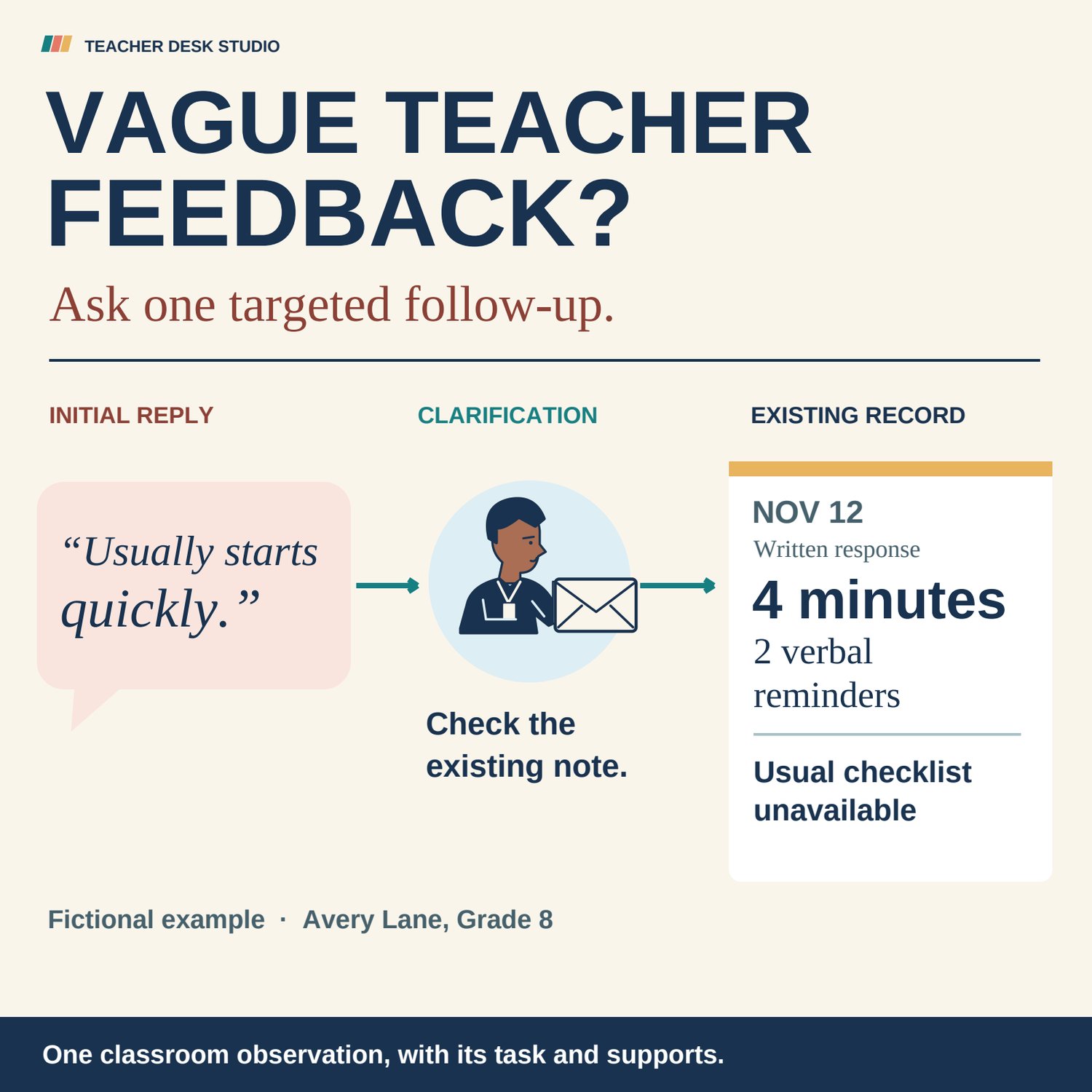
A comment like “Usually starts quickly” may be helpful as a starting point, but what does it actually tell you about the student's performance?
The IEP Teacher Input & Evidence Clarification Toolkit helps secondary special education case managers request existing classroom information, ask targeted follow-up questions, and organize available evidence for professional review.
Designed for Grades 6–12 special education teachers, resource teachers, and IEP case managers.
WHAT MAKES THIS TOOLKIT DIFFERENT?
It goes beyond collecting teacher input.
Many teacher input forms help you gather classroom observations. This toolkit also helps you decide what to do when a response is incomplete, unclear, or unavailable.
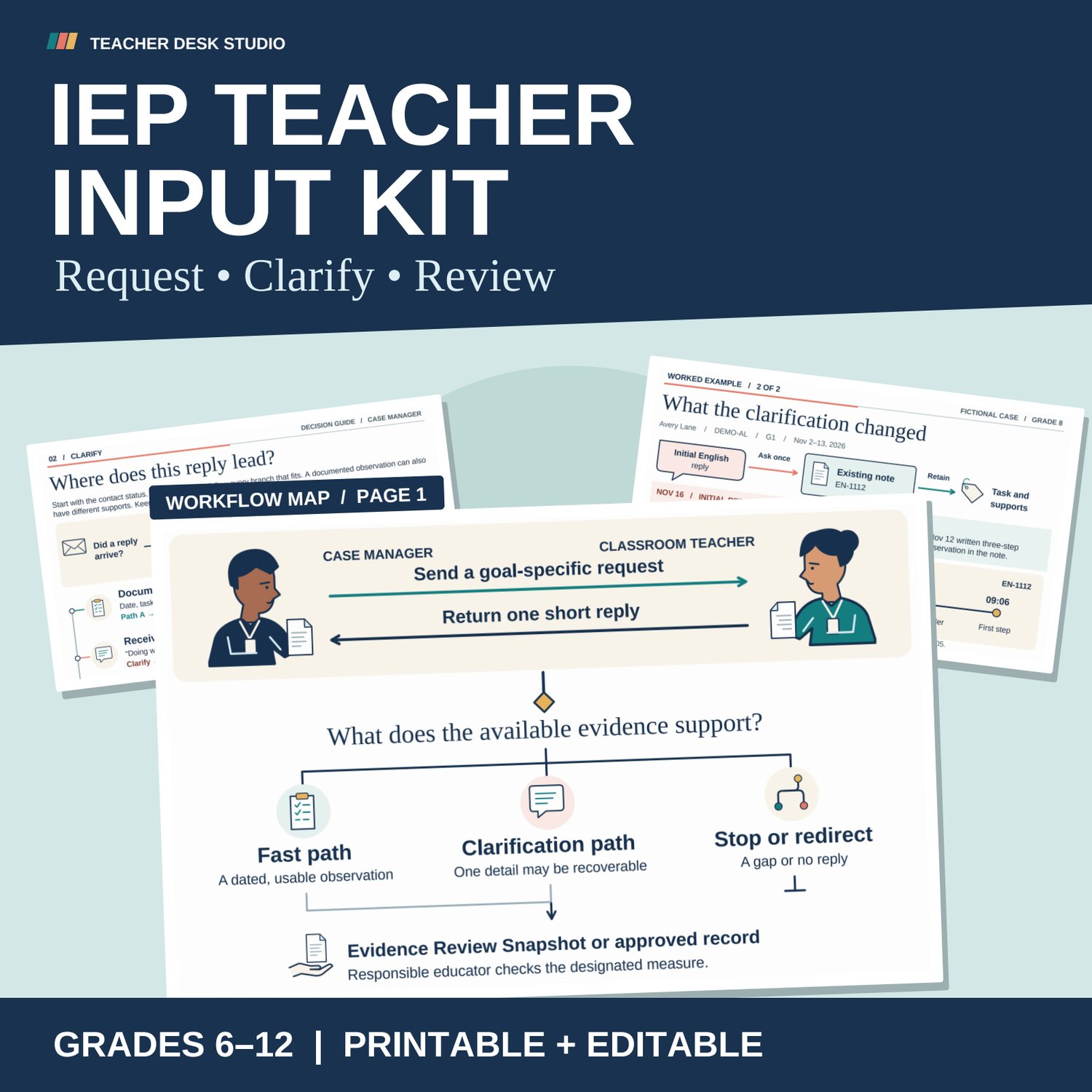
Follow a simple, teacher-guided workflow:
REQUEST → CLARIFY → REVIEW
- Request existing, goal-relevant classroom information.
- Clarify one important missing detail when an existing record may provide it.
- Review documented observations with their sources, task conditions, supports, and remaining limitations.
Not every situation requires every form. Use the quick response option for straightforward situations and the clarification tools only when needed.
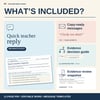
WHAT'S INCLUDED?
You'll receive four digital files:
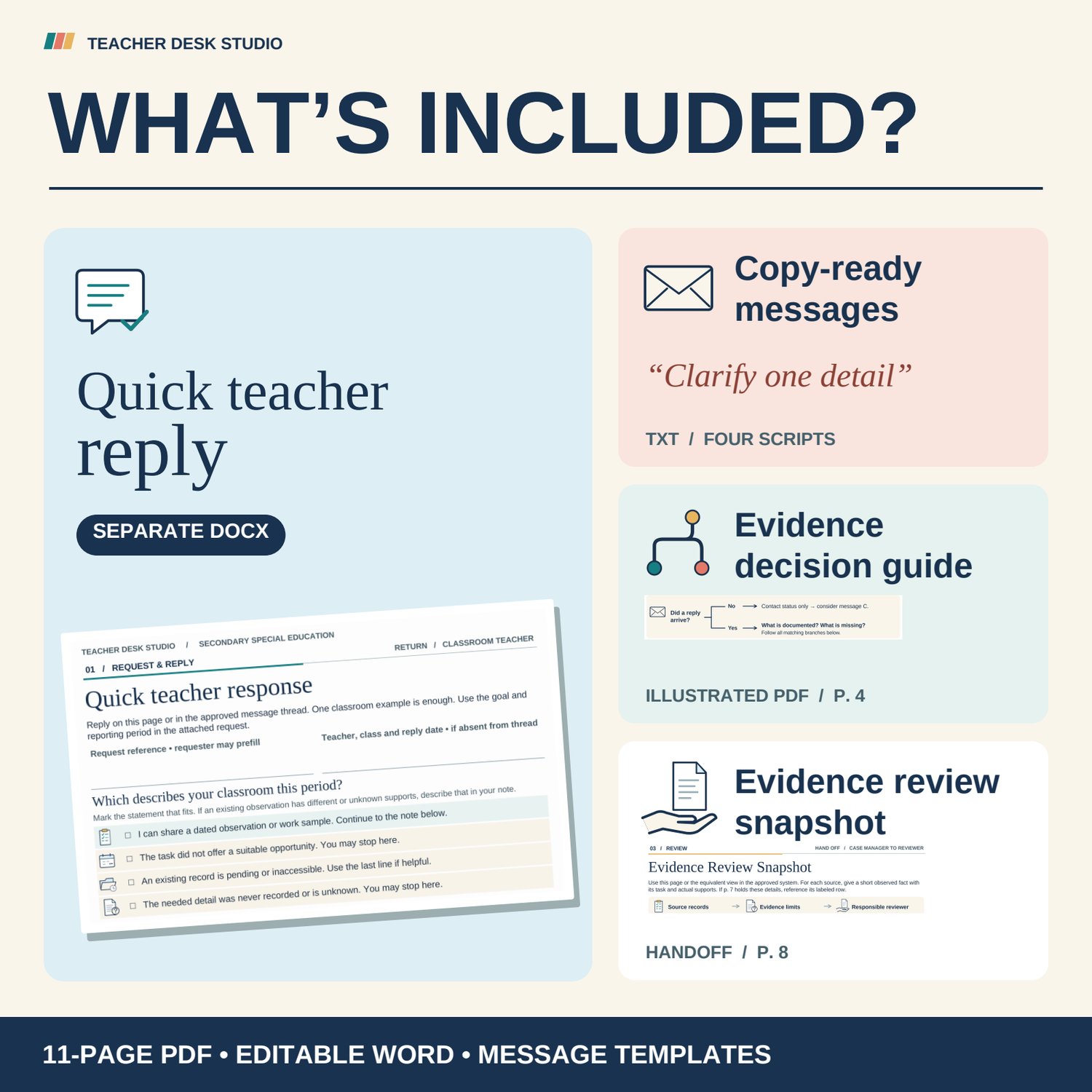
1. Illustrated Teacher Input & Evidence Toolkit — 11-Page PDF
A printable guide and set of professional working forms featuring:
- Goal-specific teacher input request
- Quick classroom teacher response
- Illustrated evidence-status decision guide
- Optional evidence-gap action record
- Copy-ready communication examples
- Classroom evidence source comparison
- Evidence Review Snapshot
- Responsible educator review guide
- Two-page fictional worked example
2. Editable Word Toolkit — DOCX
Customize headings, school terminology, instructions, and response fields. Type directly into the forms, with space that can expand for longer responses.
3. Quick Teacher Response — Separate Editable DOCX
Send a shorter, standalone response page to a classroom teacher.
Teachers can share an existing observation or indicate when no suitable observation opportunity or record is available—without inventing missing information.
4. Four Copy-Ready Teacher Messages — TXT
Adapt professional wording for:
- Requesting existing classroom information
- Clarifying one material detail
- Following up on an unanswered request
- Acknowledging unavailable evidence or no suitable observation opportunity
Use these messages through your school's approved communication channels.
HOW IT WORKS
STEP 1 — REQUEST
Identify the relevant IEP goal, reporting period, classroom task, and information you need.
Provide a concise request and an easy-to-use teacher response form.
STEP 2 — CLARIFY WHEN NEEDED
Review the response.
Does it include a specific observation? Is the date known? Were prompts or supports used? Is an important detail missing from an existing record?
Use the illustrated decision guide and one targeted follow-up when appropriate.
STEP 3 — ORGANIZE FOR REVIEW
Keep each observation connected to its source, date, task, and support conditions.
Use the Evidence Review Snapshot to summarize what is available, what remains unknown, and what requires responsible educator review.
SEE A COMPLETE WORKED EXAMPLE
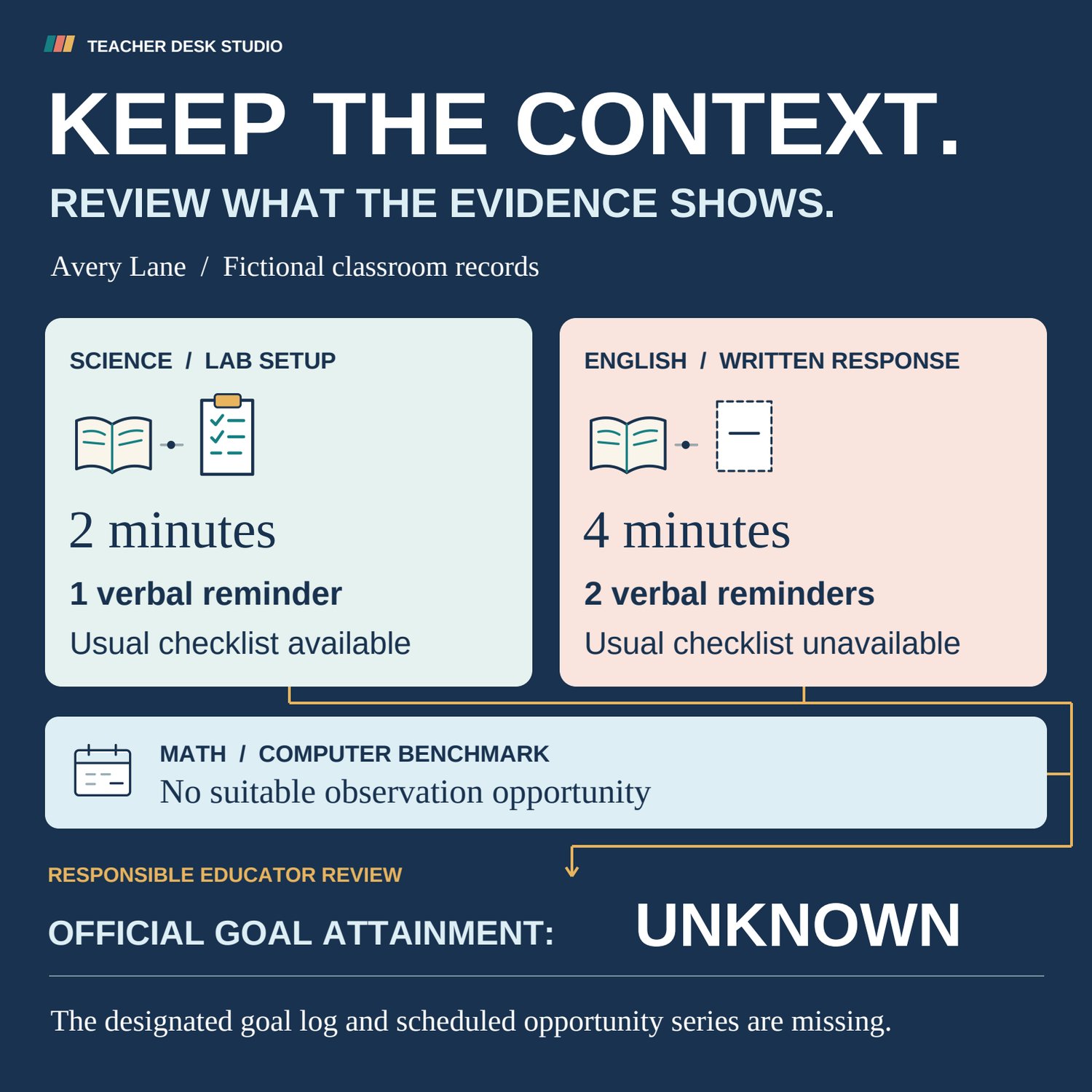
The toolkit includes an illustrated, fictional Grade 8 case showing how an initially vague teacher response can be clarified using an existing classroom note.
The example demonstrates:
- A general teacher reply
- A targeted follow-up
- A dated classroom observation
- Actual verbal reminders and checklist availability
- Different conditions across classes
- An unavailable observation opportunity
- Evidence that remains insufficient for determining official IEP goal attainment
The example shows both what the available evidence tells you and what it cannot establish.
IDEAL FOR
- Middle school and high school IEP case managers
- Special education resource teachers
- Requesting general education teacher input
- Quarterly IEP progress-report preparation
- Reviewing incomplete classroom observations
- Clarifying teacher feedback
- Organizing evidence from multiple classroom settings
- Preparing information for responsible educator review
WHY TEACHERS MAY FIND IT USEFUL
Less unnecessary paperwork
Use the fast response path when the available information is sufficient. Additional forms are optional and situation-dependent.
Professional follow-up wording
Start with editable messages instead of drafting every clarification request from scratch.
Visual guidance for evidence gaps
Use diagrams and decision aids to identify an appropriate next action.
A clear evidence handoff
Keep observations, conditions, source references, and unresolved questions organized for review.
An example that explains the process
See how a fictional case manager handles vague feedback without treating missing information as a zero or an unsupported progress conclusion.
PRODUCT DETAILS
Grades: 6–12
Primary Audience: Special Education Teachers, Resource Teachers, and IEP Case Managers
Main Toolkit: 11 printable pages
Files Included: PDF, editable DOCX toolkit, separate editable DOCX teacher response, and TXT communication templates
Language: English
Use: As needed for teacher input collection, clarification, and IEP progress-reporting preparation
Printing: US Letter (8.5 × 11 inches)
IMPORTANT INFORMATION
This is a teacher-guided information collection and review resource, not an automated system.
It does not calculate IEP goal attainment, replace the measurement method specified in an IEP, generate official progress reports, or certify legal compliance.
Classroom observations may provide helpful context, but they do not automatically replace designated IEP progress-monitoring data.
Follow school and district procedures for reporting, staff responsibilities, and confidential student information.
The worked example is fictional. No real student data or classroom testing is represented.
Request clearly. Clarify what matters. Review evidence responsibly.