

Balancing Chemical Equations & Conservation of Mass | Visual Models Unit
What you get: A ZIP file (2 MB) of printable PDFs.
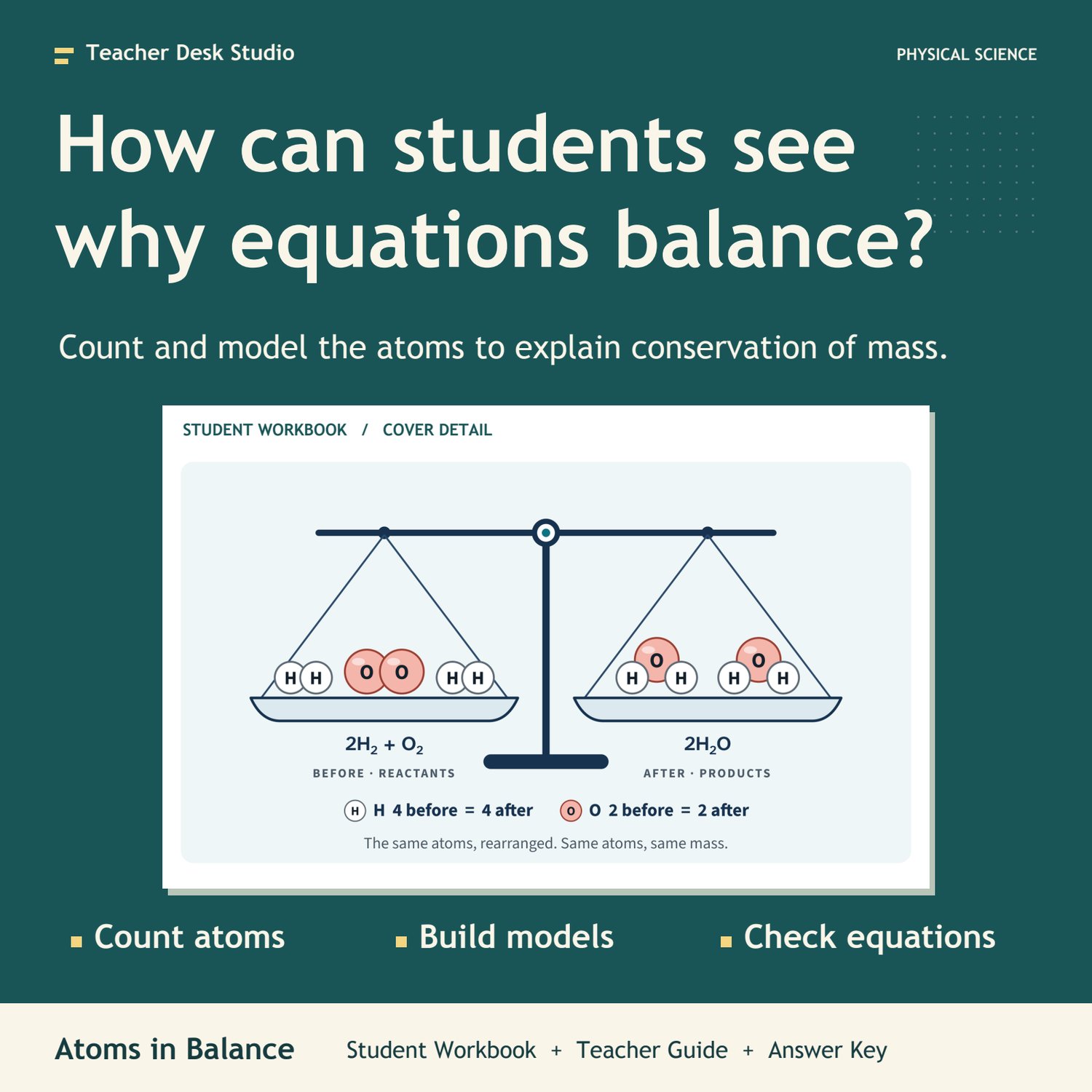
Help students understand WHY chemical equations balance—not just which coefficients to write.
Atoms in Balance is a printable, ready-to-teach physical science mini-unit that helps students count atoms, interpret particle models, compare reactants and products, and explain the law of conservation of mass.
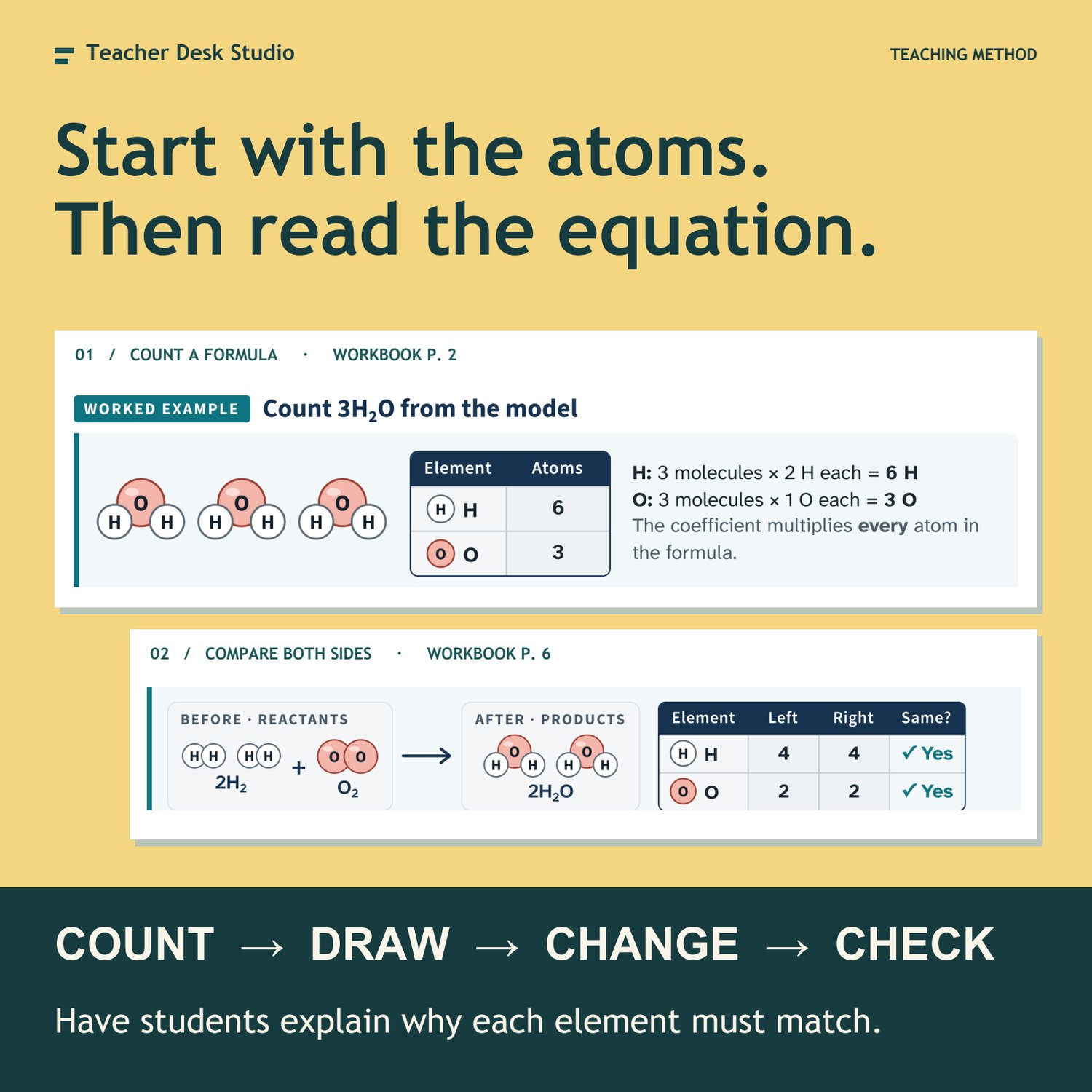
Instead of beginning with trial-and-error balancing, students work through a visual learning sequence:
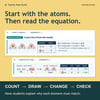
COUNT → DRAW → CHANGE → CHECK
They begin with chemical formulas and atom counts, use particle models to represent reactions, and gradually move toward independent reasoning. Symbolic equation balancing is included as an optional extension.
What's included?
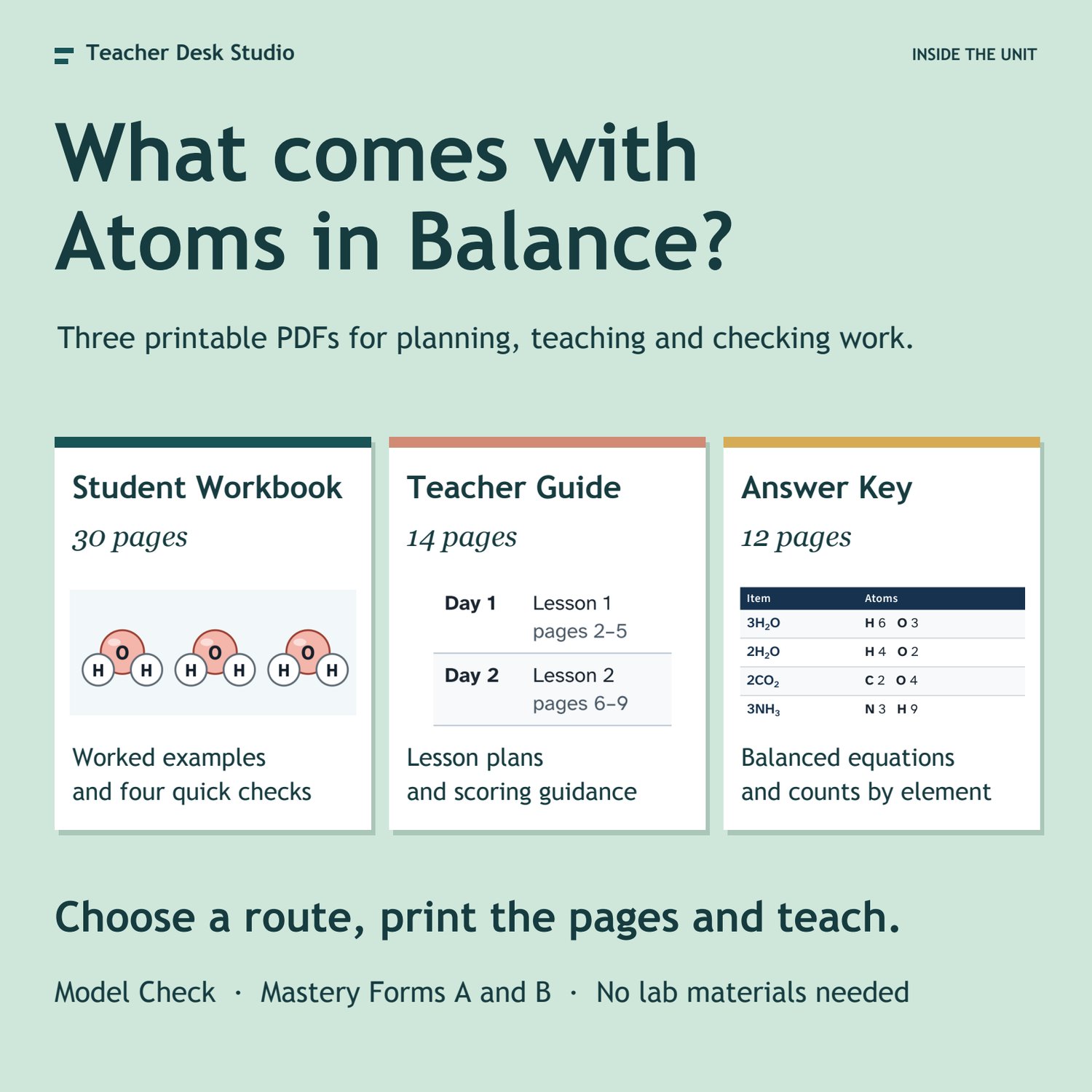
56 pages across 3 printable PDF files:
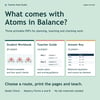
- 30-page Student Workbook: Five connected lessons with worked examples, guided practice, independent activities, particle models, atom-counting tables, and error analysis.
- 14-page Teacher Guide: Lesson-by-lesson plans, pacing, printing guidance, instructional support, common misconceptions, and scoring guidance.
- 12-page Answer Key: Worked solutions, balanced equations, element-by-element atom counts, and assessment answers.
The resource also includes four Quick Checks, an 18-point Model Check, two 20-point Mastery Forms (A and B), a student reference card, and printable atom pieces.
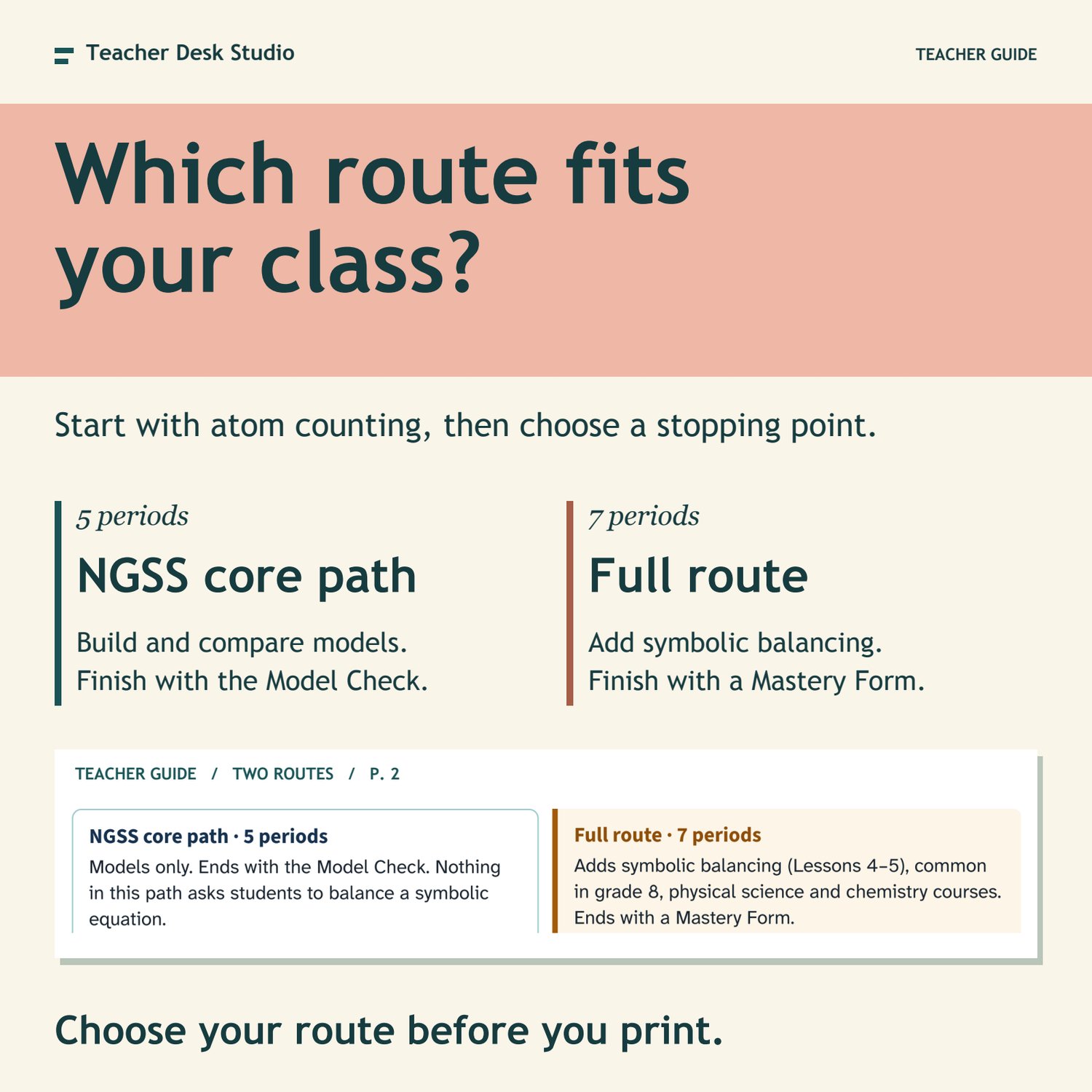
Two flexible teaching routes
Route 1 — NGSS Core Path | 5 class periods
Focus on counting atoms, interpreting and building particle models, comparing reactants and products, and explaining conservation of mass.
This model-focused route is designed around NGSS MS-PS1-5 and its assessment boundary. Students are not required to balance symbolic equations by choosing coefficients.
Finish with the 18-point Model Check.
Route 2 — Full Route | 7 class periods
Extend the core instruction into symbolic chemical equation balancing.
Students practice selecting coefficients, checking element counts, recognizing common mistakes, and applying their understanding to chemical reactions.
Finish with Mastery Form A or B.
Skills students practice
- Distinguish coefficients from subscripts.
- Count atoms in chemical formulas, including formulas with parentheses.
- Identify reactants and products.
- Interpret and draw particle models.
- Check whether each element is conserved.
- Explain conservation of mass using evidence.
- Balance introductory symbolic equations in the extension lessons.
- Identify and explain errors in chemical equations.
Who is this resource for?
Designed for 8th-grade physical science, with additional applications in high school physical science and introductory chemistry.
Use it for whole-class instruction, guided practice, small-group support, reteaching, review, or introductory chemistry instruction.
Easy classroom preparation
Print the pages for your chosen route, follow the Teacher Guide, and use the included Answer Key and assessments to check student understanding.
Suggested duration: 5–7 class periods of approximately 45 minutes each (about 1–2 weeks).
Format: Three printable PDFs. No lab materials or additional software required.
Science and safety note: This resource uses paper-based particle models and clearly labeled hypothetical mass-conservation scenarios. It does not include procedures for conducting chemical reactions or classroom lab experiments. Follow school-approved safety procedures for any separate demonstrations.
Give students a visual way to understand what balanced equations actually mean—with teacher guidance, practice, and assessment in one focused unit.
Teacher Desk Studio | Atoms in Balance